

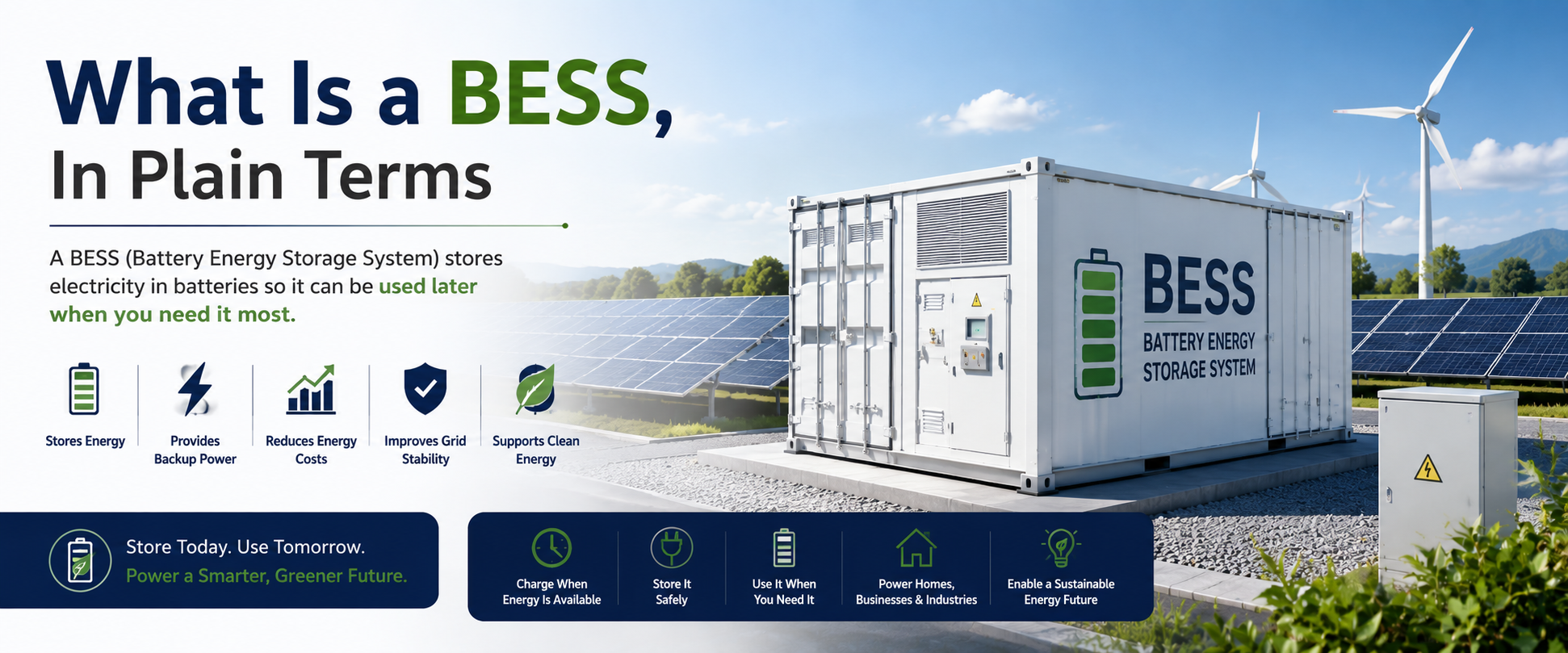
What Is a BESS, In Plain Terms
A Battery Energy Storage System (BESS) is a set of rechargeable batteries, paired with power electronics (inverter/converter) and a control system (BMS — Battery Management System), that stores electrical energy so it can be used later instead of immediately.
For a solar+BESS system, the flow looks like this:
- Solar panels generate power during the day.
- Your building uses what it needs in real time.
- Surplus power charges the battery instead of being exported to the grid.
- In the evening, at night, or during a power cut, the battery discharges to power your building — instead of you drawing costly grid power or running a diesel generator.
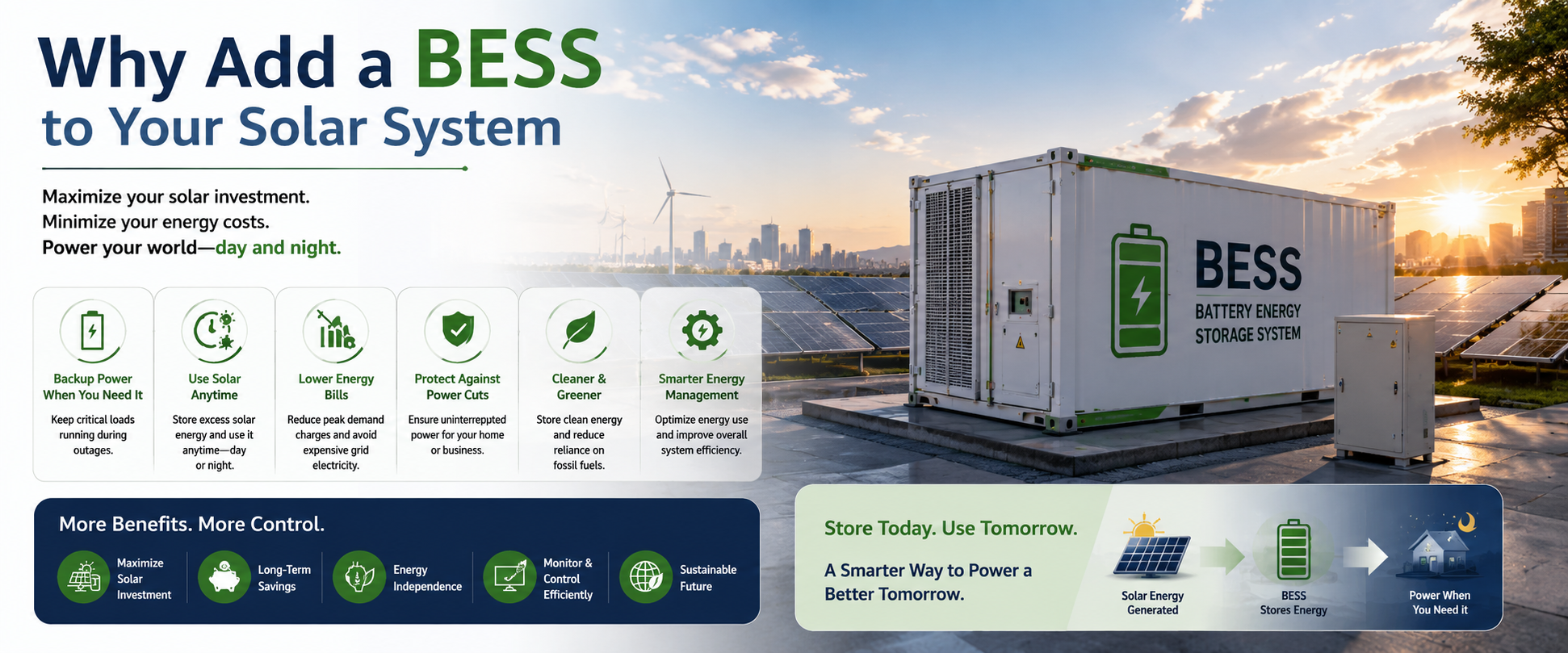
⚡ Why Add a BESS to Your Solar System
1. Backup Power Without Diesel
Keep critical loads running during outages — silently, with no fuel cost, no fumes, and no generator maintenance.
2. Time-Shift Your Solar to the Evening Peak
Most commercial and industrial demand peaks in the evening, exactly when solar generation is zero. A battery lets you use your own solar power hours after it was generated — cutting reliance on expensive grid import during peak tariff windows.
3. Reduce Demand Charges
Many commercial electricity bills charge based on your highest instantaneous demand (kVA), not just total units consumed. A BESS can "shave" these peaks, lowering your monthly demand charge.
4. Protect Against Tightening Banking Rules
As DISCOMs move toward stricter same-slot or monthly banking (rather than unlimited annual banking) for solar export, a battery lets you consume your own surplus directly — instead of depending on the grid to "store" it for you at a rate you don't control.
5. Regulatory Readiness
In Maharashtra, new commercial and industrial rooftop and open-access solar projects above 100 kW are now required to co-locate storage under the state's storage mandate — making BESS a compliance requirement, not just an option, for larger systems.
Types of Battery Technology We Work With
| Technology | Best Suited For | Key Traits |
|---|---|---|
| Lithium Iron Phosphate (LFP) | Most commercial & industrial rooftop projects | Long cycle life, strong thermal stability, no cobalt, industry-standard choice for solar + storage today |
| NMC (Lithium Nickel Manganese Cobalt) | Space-constrained sites | Higher energy density, slightly lower thermal margin than LFP |
| Lead-acid / Tubular | Small backup-only setups, budget-constrained residential | Lower upfront cost, shorter lifespan, larger footprint |
Key Terms, Explained Simply
⚡ kWh (Kilowatt-hour)
The total amount of energy a battery can store — its "tank size."
🔌 kW (Kilowatt)
The rate at which the battery can charge or discharge — its "tap size."
📈 C-rate
How fast a battery can be charged or discharged relative to its capacity.
🔋 Depth of Discharge (DoD)
How much of the battery's capacity is safely usable before recharging. High-quality LFP systems typically allow 80–90%+ DoD.
🔄 Cycle Life
The number of full charge-discharge cycles a battery can handle before its capacity noticeably decreases.
🛡️ BMS (Battery Management System)
The onboard electronics that protect the battery from overcharging, overheating, and imbalance between cells.
⚙️ Hybrid Inverter
The inverter that manages power flow between solar panels, battery, your building's load, and the grid — the "traffic controller" of the system.
How Solaireko Sizes Your BESS
We don't sell a fixed battery size — we size storage against your actual load profile and tariff structure, ensuring the system delivers maximum performance, compliance, and return on investment.
📊 1. Load & Bill Analysis
We analyze your electricity consumption pattern, peak demand, and time-of-day tariff exposure to understand your energy requirements.
⚡ 2. Backup Requirement
We identify which loads need to remain powered during outages and determine the required backup duration.
📋 3. Regulatory Sizing
For systems above 100 kW in Maharashtra, we ensure compliance with the state's minimum storage mandate requirements.
💰 4. ROI Modeling
We balance battery investment against demand charge savings, peak-tariff optimization, and backup value, ensuring you only pay for the storage capacity you truly need.
❓ Frequently Asked Questions (FAQ)
Do I need a BESS with my solar system, or is it optional?
For most small residential systems, a BESS is currently optional and is mainly used for backup power. For commercial and industrial systems above 100 kW in Maharashtra, storage co-location is now a regulatory requirement for new projects.
How long does a BESS last?
Quality LFP systems are typically designed for 10+ years or several thousand charge cycles, depending on usage patterns and how well the system is sized and maintained.
Can I add a battery to my existing solar system later?
In most cases, yes. Your inverter must be hybrid-capable or compatible with a retrofit solution. Our team assesses this during the free sizing visit.
Is a BESS safe for indoor installation?
LFP battery systems from reputable manufacturers, installed with proper ventilation and a certified BMS, are widely used in commercial indoor and outdoor settings. We follow manufacturer and electrical safety guidelines for enclosure, ventilation, and fire protection in every installation.